

We are attracted to easy, all-encompassing explanations. The trends that give us an idea of what other people will probably do in a given situation. ‘But I’m an individual’ you say, ‘I’m unpredictable’. Yes, we are all individuals. But I was introduced to one of these magic ratios fifteen years ago and have seen it all around me ever since.
I was working for Birmingham City Council as a Rent Manager when I attended training given by the West Midlands police in 2009. It was on fraud. A constant concern for us was benefit fraud, tenants claiming benefit for living separately but actually living together, or sub-letting Council homes to others. Rarely, the properties were sealed up by tenants and turned into hot-houses to grow cannabis. The main message from that training was quite profound. In every hundred people, eighty will commit fraud in certain conditions. Ten will absolutely not break the law under any circumstance and the other ten are habitual fraudsters already.
This is the 10-80-10 rule of ethics. That 10% of people will always do the right thing, 80% will go with the flow right or wrong, and 10% are willing to take risks to make things better.
The presenter went on to show us the fraud triangle. It consists of three sides: opportunity, motivation and rationalisation – with fraud in the centre. Reducing any of these factors reduces the possibility of fraud.
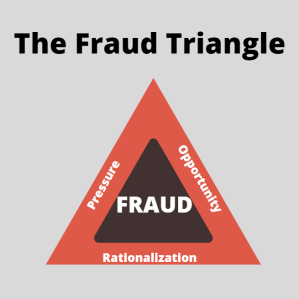
This shocked me. I thought about it a lot and still do. I had assumed that the number of people open to committing fraud would be a lot lower. Think of the motivations and rationalisations required to commit ‘acceptable’ fraud – great injustice, personal desperation, or making a stand for your principles or your family. A deeply inadequate benefits system was pushing people into poverty motivating people to ‘play’ it. It left me believing that we need to understand why people make difficult choices, and change the situation they find themselves in, rather than catching and punishing them.
The 10-80-10 ratio is found all over. In the workplace, 80% of employees are productive, 10% are elite and 10% of difficult and unproductive. In sales, you listen 80%, ask questions 10% and talk about your product 10%. In nutrition, we are told to get 80% of our calories from carbs, 10% from protein and 10% from fats, and even the recipe for preparing the perfect home-made dog food follows this ratio; 80% meat, 10% bone and 10% offal.
The trainer went on to explain that 80% of fraud is perpetrated by 20% of people. It was these hardened fraudsters that we needed to go after with new policies and targeted investigations.
This is another way of exposing trends in human behaviour, The Pareto principle. It was introduced in 1906 by Italian economist Vilfredo Pareto, who after observing pea plants in his garden, found that 80% of his pea harvest came from 20% of his plants. He suggested that 80% of outcomes are produced by just 20% of the inputs. He also observed that in wealth distribution, 80% of the wealth is owned by 20% of people.
Doctor Joseph M Juran developed this into a general economic theory. He explained that 20% of a company’s staff account for 80% of the company’s production, or conversely, 80% of that company’s staffing problems are caused by 20% of staff.
He explained that you must focus 80% of your resources on the 20%, or ‘vital few’ tasks, that can be completed with the best outcome. He explained that you don’t forget about the ‘trivial many’ 80% of tasks that may be more time-consuming and difficult to complete, you focus your remaining 20% on them. It’s great advice if you know which tasks are which. Approaching tasks in this way is key to avoiding the societal pressures of ‘perfect world syndrome’ (a Social Media speciality) and ‘impostor syndrome’, both very common mental health issues.
Today, the Pareto principal is applied to relationships, sport, personal finances, mathematics, science and even spending habits. But beware, these ratios don’t work for everything – especially baking and making the perfect smoothie. Other ratios are available, but they get much more interesting when applied in theory to the world around us.
In ‘Man’s Search for Meaning’, Viktor E. Frankl suggests that the existential vacuum, the lack of purpose or meaning in life, is the biggest problem faced by modern humanity. He said this seventy years ago, but I think it has gotten worse. I wonder if politicians have realized that in this existential vacuum, there will be no consequences no matter what they do or say? The 10-80-10 rule of ethics tells us that 10% of politicians are corrupt, 80% are open to corruption, and 10% are absolutely not. When you apply the same ratio to the public, 10% will want their elected representatives to do or say even worse things, 80% of society is happy to go with the flow, and 10% will object. This 10% is a dangerous minority that would probably form the resistance to a dictatorship. They never supported those corrupt politicians anyway. Once they have been excluded from voting and laws have been passed to limit, remove, expel, or neutralize them, they no longer pose a threat.

Is it a coincidence that a 2008 study into voyeurism in Canada found that 79% percent of participants would happily watch someone they found attractive undress if they knew they would not get caught?
Can the 10-80-10 rule be used to explain the apparent division in society’s approach to public health? That 80% of people are happy to follow the narrative that the pandemic is over, 10% think it was only ever a conspiracy, and the remaining 10% continue to self-isolate, still wear masks in public and can’t understand why other people aren’t taking the Pandemic seriously. Be honest, which are you?
Living in a world full of unpredictable, free-thinkers would be very difficult. We need these simple ratios to help explain our lives. But these trends only crudely forecast our group behaviour, not the reasons for the choices we make. After all, ‘We’re all individuals.’
Richard C Brown MBE
July 2025
 World According to Me:
I really hope I am not inadvertently committing fraud with regards to my disability pension.
LikeLike
Speaking for the UK, the process of qualifying for ANY payments is so unpleasant and difficult that it makes ANY fraud very unlikely!
LikeLiked by 1 person
I guess the disability support pension here is like a ‘set and forget’ payment. I’ll make a post about this, hopefully
LikeLike