
Not a bad first day I thought as I buttoned up my overcoat and looked for my hat.
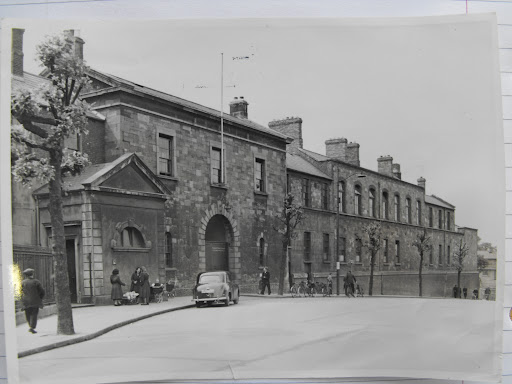
St. Kevin’s Hospital occupies what used to be the South Dublin workhouse and many of the souls that found their way here were often deeply troubled. It was a tough challenge for a newly ordained priest for sure. There were three sharp knocks at the chapel door, before I could react, the handle turned and a slight, austere woman wearing a nurses’ uniform entered. Looking me dead in the eye she said “I’m sorry to disturb you father. I have a patient who is ready to receive the last rites. I began to unbutton my overcoat. Although I put her her mid 50s, she reminded me of many of the older nuns I knew, over-zealous and impatient. The objects in my leather bag rattled as I picked it up. “Well Matron, you had better take me to him.”
As we crossed the courtyard and felt the cool evening air, she added, “The poor man is a veteran of the Great War, he came to us with a throat problem. It was badly infected and we found cancer. He has since developed sepsis. He has been heavily sedated, drifting in and out of consciousness, he thinks he is back in the trenches.” I knew she wouldn’t have disturbed me if the matter could have waited until tomorrow. Showing some compassion, she added “I was going to call for you this evening, but then he was wide awake, his eyes were clear, he took some food and seem to be much improved.” She seemed slightly irritated by this turn of events. “I have seen this so many times before father. Just before a person dies, they rally with great clarity. Often, the patient’s family see it as miraculous, a beginning of a recovery. I see their hope returning – but I know it is the soul getting ready to leave this earth.”
I trusted her instincts. “Well, I am here to help him. What’s his name?”
“William Walsh, do you know him?” The matron looked at me closely, expecting a flash of recognition.
“No” I replied with uncertainty. That was the way of the priesthood, you met a lot of people and were somehow expected to remember them all.
“Well, he certainly knows you father. He’s been asking to speak to you all evening.”
I connected the dots. “I wonder if he knew my father, he was a chaplain at the Western front.”
We entered through the double doors at the end of the ward. As we passed a row of beds with sleeping forms on each side. I became very much aware of the sharp sounds the matron’s heels were making on the hard floor, they reminded me of gunshots. I wondered if this was a signal of her approach, to set nurses and patients alike on edge. A screen had been pulled around the bed at the end and a strong warm light came from within. We stopped, matron drew back the curtains and nodded for me to go through. As required, a crucifix and two large candles had been lit and were sitting on the bedside table, casting a warm yellow glow. The sweet scent of incense hung in the air.
The man in this bed had short dark hair, it was receding slightly and greying at the temples. His pale skin looked unusually smooth and his nose was proudly aquiline. A heavy bandage was wrapped around his throat. He did not look like a dying man at all. I took his hand and felt the rough skin of one who has worked a lifetime. “Good evening William, I am Father Casey.” He sat upright as matron set his pillows behind him. His clear blue eyes opened and focused intensely on me. My heart sank slightly as I saw his warm smile of joyful recognition. He cleared his throat.
“Why father, you don’t look or sound a day older than when saw you last.”
“And when was that? I asked, still not recognising him and still hoping to gather a vital clue.”
“It was Christmas 1920 in Cologne. What a time of it we had, eh!” He winked conspiratorially as matron backed hastily out of the cubicle. I wondered if he was still delirious.
I sighed. “I’m sorry, that may have been my father, I wasn’t even born until 1925.”
He closed his eyes and sank back into the pillow, still smiling. “Well if you say so. But you are a father Casey and you have come to help me on my way.”
William looked through me into the distance. He had obviously spent some time trying to identify this very important moment himself. After a few seconds, he took a deep breath. “It started before I even joined up. There were so many people telling us what to do. They say poor Pope Pious X died of a broken heart the day the war broke out. His successor, Benedict XV, condemned the coming war as a European suicide. The Catholic Church in Ireland called it a righteous war and urged us to fight the darkness that was spreading across Europe. The Fenians said that we Irish should be fighting alongside Germany. I was young and just wanted adventure with my friends. He paused and our eyes met. “This message of fighting darkness hit home with you Jesuits, you went into battle with us.”
He was right. To preserve a confidence between us, I drew my chair close to the bed. I spoke in the softest voice I could, nearly a whisper. “We will start with your confession, so you can enter the kingdom of heaven free of sin. How long has it been?” Straight away, I saw pain explode across his face. This was going to be difficult.
His eyes filled with tears. “I have seen things father, things I have not been able to tell anyone else. But I can tell you, because you were there with us, and I know I am dying. You see Father, I lost my faith when I was in France and never got it back.”
I remembered how even my own father had struggled with his faith for the rest of his life after the war. I tried to put this man at ease. “A repentant sinner can always come back to God. Especially one who has fought for God and country. When did your doubting start?”
“The first time I had to kill man with my bare hands, hear his pleas for mercy and see the light dying in his eyes. That was when I knew I was lost. And It just got worse each time after.” He began coughing. It soon became uncontrollable, like great sobs as he struggled for breath like a drowning man.
After a few moments, the coughing subsided and he took several breaths before continuing. “The first time was at Transloy Ridge on the Somme in October 1916. Our objective that day was to take and hold some German gun pits. It quickly became hand to hand fighting. It was our first proper action since our entire battalion was all but wiped out at Mousetrap Farm in 1915.” I survived that, but took some gas. He gestured to his throat. “I knew that I was a dead man walking from that day. I numbed myself to my own death, killing my enemies and losing my friends. It was the only way that any of us could survive.”
“I saw the mines detonate at Messines. Nearly one million pounds of explosive under the enemy lines. The whole horizon seemed to lift slowly into the air, breaking into chunks as it rose, the early morning sunlight pouring through the cracks between. Many thousands of men were killed in an instant, just vapourised. They were lucky. Further away, the wave of concussion killed many more as they waited in their trenches for our attack. It was an eerie sight as we cleared their trench. When going through the routine of trench life, eating, sleeping, shaving, playing cards or standing guard – they were all crumpled on the ground like marionettes who’d had their strings cut. There was no one to fight, nobody left alive.”
“I saw men drowning in mud at Passchendaele, I saw bodies of those who had died there in the fighting over that ground years before – my dearest friends – that had just been left to the rats – visions of hell. Where was God? How could he let all that happen? All that cruelty, all that hate.”
“I could never understand why I survived instead of the others. Sometimes I would be in a line of fellas making our way along the trench. I’d stop to light a cigarette or to have a quick chat, the fellas in front of me would round a traverse, there would be a direct hit from a shell, an explosion and I never saw them again.” His body shook. “I should have done something. I should have saved them.”
I understood his line of thinking, I was familiar with the recent work on survivor guilt by doctors in New England. “You can lose your faith, but God is always there with you. Just as He is with everyone in their last moments.”
He thought about this. “Was He with the men I killed too? They prayed to Him, had church services and parades on Sundays and chaplains too, they even had God with Us stamped on their belt buckles.”
I gave what little reassurance I could. “The true light of God never shines upon the conqueror.” I said solemnly. “Your actions saved countless lives and you must always remember that.”
The flames of both candles guttered violently as if a window had been opened nearby and the cold night air had forced its way in. I looked up. William was gazing into the dancing flames. I realised that the air around us had become saturated with his pain. I did not wish to make him relive such traumatic experiences any more, I told him that God knew all of his sins and he did not need to detail them between us. He looked gratefully me and the candles calmed.
His confession heard, I gave the Apostolic Pardon, absolving him from every sin he had ever committed.
I sensed his relief as I set about anointing him with the blessed olive oil I carried in my bag. As I touched his eyelids, I whispered “Oh the wonders things these eyes must have seen.” When I anointed his rough and calloused feet, he murmured “These feet have marched me all over Europe.”
Now his confession had been heard and he was prepared for his final journey, I wanted to change the focus and encourage him to try to find the positives in his ordeal. To end with a feeling of pride. “He was also there during every moment of bravery. The countless lives you saved. Can you tell me about one of the moments when you felt that you were doing his work, when you were answering his call? A moment that changed the war?”
William closed his eyes and a smile touch the corners of his mouth. “There was one man who saved many lives with his quick thinking. “Our commanding officer Major Wheeler, saved 200 of us and helped put a stop to the German offensive in March 1918.”
“Reinforcements from the eastern front were swelling the German ranks and we knew they were planning something big. With American troops on their way, we were hoping to be out of the frontline when it came. The heaviest barrage I have ever seen began early on 21 March. There was gas, high explosive, shrapnel and trench mortars firing continuously. By the afternoon, our section had taken a few direct hits and was obliterated. Many of our men were gassed, killed, wounded or driven insane.”
He shook his head slowly. “That was the beginning of the end of the 16th Irish division. We spent the next few days repelling attacks and desperately falling back over our reserve lines towards the Somme river.” He paused. “You must understand, we were the very last line, there was nobody else behind us.”
“After a week of falling back, we were holding the ground at Rosieres a few miles east of the Somme river. The ground had been fought over before, but the chalky soil and the mild winter had not turned it into the lunar landscape that we had fought in at Ypres. There were trees still standing and hedges and fields, the birds sang in the mornings. The Germans shelled our positions at dawn, and attacked from the east. We had no more ground to give. Our orders were to Hold on and fight to the last. We repelled attacks for 6 hours and were low on ammunition.
“You see, their tactics had changed and the attacks were hard. First of all, they came in small groups of what they called ‘storm troopers’ who would try to fight their way into your trench before working along it with flamethrower and grenade. These were tough, proper killers and very effective. The bulk of their infantry would follow, mopping up and moving forward as quickly as possible.”
“After an afternoon of fighting, we started to take fire from our flank. A red flare rose in the evening sky. We paused to watch as it twirled back to earth in preternatural silence. It was either from our lads being overrun or from the German storm troopers signalling for infantry support. Either way, it was our signal to go. Our orders were to hold on and fight to the last, I knew was falling back was not an option. We could hear small arms fire and explosions along our trench and getting nearer. We could hold off the storm troopers or an infantry attack, but not both. There were no reinforcements coming. I was ready to die.
“But you survived, were you taken captive?”
William smiled. “Not that time, but it looked very bleak. At that very moment, our Whippets saved us.”
Enter the Whippets
“What’s a whippet?” I asked.
“The medium Mark A Whippet, what they called a tank. Smaller than the Mark IV, it was still the same basic shape. It weighed half as much, but was several times faster. Instead of a crew of eight, It had three, was armed with machine guns instead of a couple of 6 pounders. Think of it as cavalry. With a top speed of 10 miles an hour, It could harry, engage and pursue the enemy, although it couldn’t really cross trenches, it was ideal for covering the more open ground we were fighting over. I counted 12 of them that day. They rumbled over our trench with a small platform the engineers had installed and roared along our front line. They fired down into the storm troopers and then turned, heading towards the enemy, our cheers and whistling following them, to break up the infantry attack.”
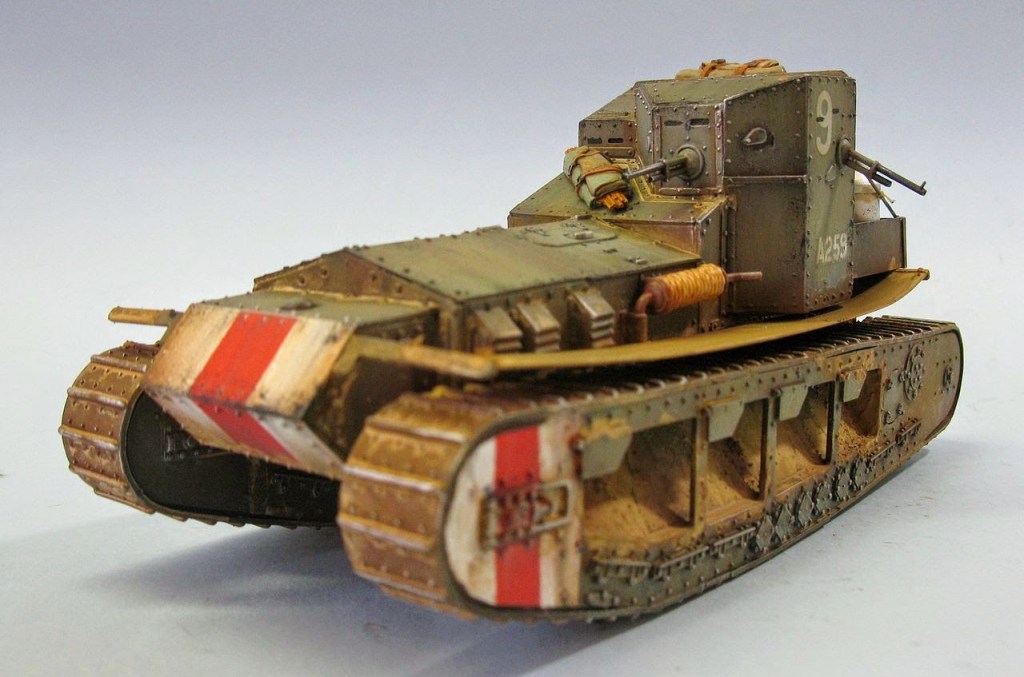
“After a long few hours, we counted just 6 back, the others must have been knocked out, bogged or broken down. The crews were ordered to destroy the vehicle before abandoning it. Whenever they could, the Germans would recover and rebuild them and put them back into use against us.”
“We were finished, plenty of us were wounded and our ammunition was all but spent. We knew that the Germans would be behind us soon. As we were in danger of being surrounded, and our position was no longer of any value, our commanding officer, Major Wheeler, decided to countermand our orders and withdrew at dusk with the remaining Irish units.”
“And it’s a bloody good job he did, he saved our lives and I think he started events that ended the war six months later. With a nod to the evacuation at Gallipoli in 1915, a lone Lewis gunner was left in the trench with orders to fire random bursts to cover our withdrawal at dusk.”
“His plan was to fall back the 5 miles to the Somme river, where we were hoping what was left of our lads would be fighting and we could descend on the rear of their attackers. We formed a column of about 300 Irish soldiers. We Dublin Fusiliers led the group, followed by, Munsters, and Irish Guards and our combined walking wounded. Our spirits lifted when we found the main road and began to follow it to the river.”
“We passed through Morcourt, a small village that had been recently abandoned. Some of the rooves were on fire, possibly from stray shells. Doors and windows hung open like missing teeth. Belongings were strewn about and only stray dogs and the occasional chicken were the only things visible in the streets. As we reached the edge of the village, Major Wheeler brought our column to a halt and gathered the remaining officers and us NCOs around him in an empty house.
As lamps were lit, he unfolded the trench map and placed it on the kitchen table. “Captain Stitt, as our only German speaker, you will lead a small group to scout along the south bank of the canal to the bridge here at Cerisy. You will secure the bridge and take prisoners if you can. We will follow as best we can but will be about 10 minutes behind you. We will provide support if necessary.” He continued. “We don’t know what we will find, so you’ll need to keep gunfire to a minimum.”
“This situation calls for a special set of skills, we need our pugilist.” Confused glances passed between us. Major Wheeler called for his orderly. We were pleased to see fusilier Kenneth Byrne, the divisional boxing champion enter the kitchen a few minutes later. Short, stocky and with tightly curled ginger hair, He was known to the English elements of our division as the Irish Terrier. I had spoken to Kenneth before and I liked him. He boxed in a very unusual way.”
“He had a way of prancing, always smiling, like boxing was simply play. I asked him where he learned to box like that and he told me that it was a mixture of growing up on the streets of Dublin and what his father taught him. His father was a missionary in China. As boxing was a key skill that he was required to teach, he also learned about the Chinese approach to fighting in return. When he came back, he taught his son both. “It’s all about focus,” Kenneth said “If I focus on the moment, my opponent no longer exists and I can have no fear.” I must admit, I still don’t understand, but he was one hell of a fighter and I had never seen him lose a fight.”
“Fusilier Byrne took off his jacket, unbuttoned his shirt and rolled up his sleeves. He set his rifle down carefully on his jacket.U I had seen bare knuckle fighting in Dublin and the matches were anything but quick or decisive. Lieutenant Beaumont volunteered to join our group. He won the Military Cross for bravery a couple of years ago and he was someone who inspired great confidence in a group like ours. One thing I did learn in France is that if you keep close to people like that, you give yourself the best chance of getting through.”
“And with that, the six of us prepared. It was like getting ready for a trench raid. We left our equipment, apart from weapons and field dressings, behind. We set off and soon saw the bridge in the distance. Like many of the bridges in this part of France, it was a crude steel lattice construction. We approached the bridge carefully from the cover of the side of the road.”
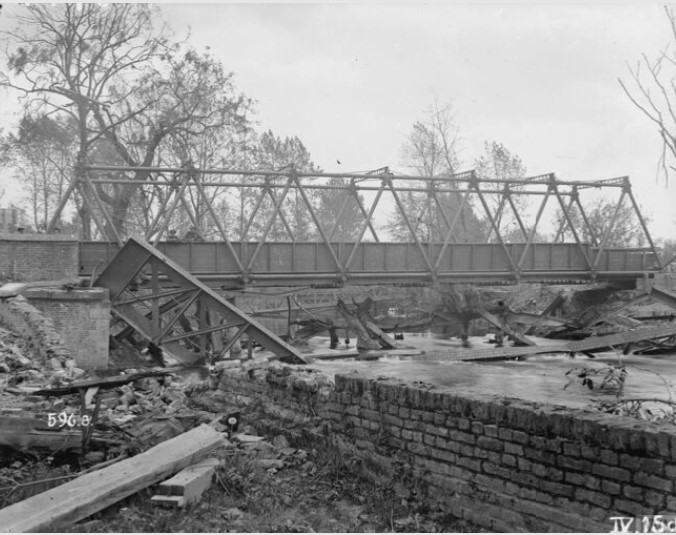
It was deathly quiet. The sun had set and mist was rising from the river. We were surprised to find nobody at all on the south side of the bridge. Indeed, there were British bodies in the foxholes and either side of the road. The smell of cordite and oil lingered in the air and the water-cooled machine gun barrels were still warm. A quick look told us the crews had fought until the last bullet, and recently too.”
“We decided to rush the bridge. Staying as quiet as we could, we split into two groups and followed each side of the bridge. In seconds, we came upon two German soldiers who were passing a cigarette between them. I was next to fusilier Byrne. The German soldier looked up just as his quick jab connected with a sharp crack and he sank to his knees. The next second, I heard a muffled gunshot and a splash from the other side of the bridge as the second soldier was taken out.”
“We continued along the bridge, the sound of the gunshot would have alerted more soldiers. As we approached the end of the bridge we stopped as four figures entered the glow of the single electric light bulb in front of us. They raised their rifles, as did we. We were in a stand-off. Captain Stitt spoke some German to them, I don’t know what he said, but it sounded very authoritative – almost like he was giving them orders. They listened, and nodded in agreement. Fusilier Byrne stepped forwards and raised his fists. The Germans lowered their rifles and looked at each other. Hey Günnar! one shouted.”
“A few seconds later, they were joined by a giant of a man. He was shaven headed his handlebar moustache was waxed into points. He was shirtless, his upper body covered with tufts of thick hair. He didn’t look pleased to have been disturbed from whatever he had been doing. There was some whispering between the Germans and Günnar looked dismissively at Fusilier Byrne. He stepped into the weak circle of light, impatiently waving the others behind him. Byrne similarly waved us back and raised his fists. Our very lives, the lives of our friends and many others depended on this fight. Günnar grinned, showing plenty of missing teeth and gestured Byrne to come toward him.”
The Fight
“I had never seen anything like it before, Kenneth was dancing and skipping around in front of the big German. Günnar grinned and looked over his shoulder, laughter arose from his companions in response. When he closed the distance between them, he swung wildly. His punches would have knocked your head off if they had connected. Byrne would simply duck under or step back and deliver a couple of blows of his own continuing his playful footwork. On their own these weren’t powerful punches, but we could see they were increasingly irritating his opponent.”
“Soon, Günnar became enraged. He rushed Kenneth with a deep roar and locked his arms around him. As Günnar straightened, Kenneth’s feet left the ground. Günnar roared again as he squeezed the air out of Kenneth’s body, I heard his ribs crack. Günnar turned to face his cheering comrades. Kenneth raised his head, and with the last of his strength, drove his forehead into Günnar’s face. He bellowed and dropped Kenneth on floor, his hands clutching his mug. Fighting for breath, Kenneth scrambled backwards on the ground and rose shakily to his feet. He was still grinning.”
“Kenneth resumed playfully dancing beyond the clumsy blows once again. Jabbing tentatively as Günnar lurched past. As the big German turned, Kenneth grinned at him. Günnar roared with anger and rushed towards Kenneth again. Waiting for this very moment, Kenneth stepped aside and gave him such a punch to the side of his head. Kenneth planted his feet and the force of the blow came from his hips. It stopped the German in his tracks. Bleeding from his nose and mouth, Günnar turned slowly to face Kenneth, spitting out several teeth and not quite believing what just happened. Kenneth stepped up close and delivered a series of jabs to his face in a blurred fury.”
“As Kenneth stepped away, Günnar sank to his knees and then to the ground with a final groan. We cheered and raised our weapons. The four Germans dropped theirs and raised their hands.”
“I went straight over to Kenneth. He was leaning delicately against side of the bridge, panting. “I thought he had you, how did you do it?” Kenneth whispered, “Focus. Sure, he may have been the stronger, but I was always faster.” We found him some schnapps that the Germans were carrying. We were joined by Major Wheeler and the rest of our group. If they could, each man patted him on the back as a they passed.”
“What did you do then?” I asked.
“Captain Stitt spent spoke to the prisoners. They were from the elite 4th German Guards division. The rest of the division had advanced as far as they could and were awaiting expecting significant reinforcements overnight. Realising that we were only a couple of hours ahead of this advancing force, and like good soldiers, we marched towards sound of small arms fire coming from Sailly-Lorette. We found a small number of German infantry partially dug in shallow foxholes. We only needed to make a small opening to get our men through and get back to our lines. We found a part of their line which looked isolated and the 6 of us went ahead and caught their sentries completely off-guard. We made short work of them.”
“At 2 AM, about 200 of us finally reached our lines at Bois Hamel, having fought all day and marched 12 miles. We slept on floors in doorways or where we fell. Just like our Lord, we had been in the wilderness of the front for 40 days and nights without relief. The next day, there was still plenty for us to do. What was left of the 16th (Irish) Division came together to form a unit under the command of Major General Carey, we were known as Carey’s Force. It was made up of pioneer and engineer troops from all disciplines and five hundred Americans and four hundred Canadians fresh from Calais. Our objective was to dig in the fields just outside the village to the east of Hamel, fight and stop the German advance. “I came here to fight, not to dig!” Exclaimed one young Canadian lad for the benefit of his friends. I remembered saying exactly the same thing on my arrival in France back in 1915. I can’t believe I was that impatient. I put my arm around him and gently reminded him to be thankful that that he wasn’t digging graves in frozen soil.”
“And it’s a good job that we are were there to help them. Those boys had just arrived and didn’t have the first idea about digging trenches, dugouts or latrines. It was for us Irish, who had dug all over the world for the last four years, to show them. We organised them into work parties and taught them how to dig properly. Let’s make this trench the best and the last one we ever dig. I told them.”
“We had to teach them how to fight too. Where to site the machine guns and how to fire them in short bursts to conserve ammunition. They didn’t know how to use their respirators. We held our ground against several waves of German infantry throughout the next day. Without proper artillery support and with our few remaining whippets breaking up their attacks, the waves were getting weaker and further apart. We were relieved by reinforcements that evening and orders to push forward were given. I believe that the 100 day advance that ended the war began there for sure. In that moment, I could feel Him with us.”
“Was that the end of the war for you?” I asked.
William sighed and shook his head. “Not for me, the 16th division fought again in 1918, but it’s Irish battalions had all gone. I was transferred to the divisional machine-gun company. What was left of the second Dublin’s ended their war at the famous Hindenburg line. Kenneth Byrne died of wounds at Le Catelet in October 1918, I heard he was taken by a sniper. I still don’t understand. I stayed as part of the occupying force in Germany until 1920.”
“The war was over, but the conflict was now within me. I remembered all of the friends I had lost and the incredible hardships we all suffered. I have never been able to put down that anger and grief.”
I drew closer and he whispered. “I am in no way ashamed. War made me who I am. It made me find strength inside myself that I never knew was there. I fought alongside the bravest men and shared many long days and nights with them. Men from Ulster, Britain and Australia.” People I only met because the war threw us together They told me about their lives and loves, secrets and dreams. “I saw places I would never have seen otherwise, I picked up bits of the different languages I heard along the way.” The war changed me. I don’t want forgiveness for any of that.”
“I have lived a good life ever since and tried to make amends. I went straight from the British Army when I was demobbed, to the Irish Free State Army. I joined the RAF in the next war, always trying to help people and save lives.”
He reminded me again of my recently deceased father in that he had carried some terrible memories of his own. He never spoke of it, even when had been drinking. I always thought it was because he was ashamed of the things he did, but now I knew that he wasn’t ashamed, he just couldn’t talk about it. After giving a final blessing, I recited the Memorare, a special appeal for the intercession of the Blessed Virgin.
I made the sign of the cross with the communion wafer and pressed it onto his tongue. He swallowed with difficulty.
As a final peace passed across his face, It had softened as though a great burden had been lifted. I watched and waited as his shallow breathing became indistinguishable, until I was sure he was with God.
Author’s Note
As William is the narrator, I wanted a contrast between the innocent Irish lad in my earlier stories meeting and learning from more experienced characters. In 1918, even though he was still only 21, William had now become one of the experienced characters himself.
To make this story all about me for a moment, I have always associated the First World War with its chaos and grief that touched so many with the way I felt about my own condition. I needed to know that someone in my family had faced, and survived a supremely difficult challenge. That I was suddenly found myself in a brutal war that I didn’t really understand, that I knew would take everything away from me. The way that William feels begrudgingly grateful that the war had “made him who he was” is really a metaphor for how I feel about my life with a chronic disability. As we had shared a journey together, I didn’t want him to get lost in frustration and depression.
After the last story, I said that I would have loved to speak to him about this time in his life. I don’t think many people did or even could discuss their experiences. I had to think how this conversation could have taken place. Who would he have spoken to? Either someone else who was there, or a priest. Father Casey was a Chaplain with the 2nd Dublins in 1918. I invented his son, who could have been with William when he died in Dublin in 1953.
As before, the places dates and key events are all accurate.
After the First World War, William served in the Irish Free State Army and joined the RAF in the Second World War. There are plenty of stories here that deserve to be written.
Richard C Brown MBE – March 2026
 World According to Me: