
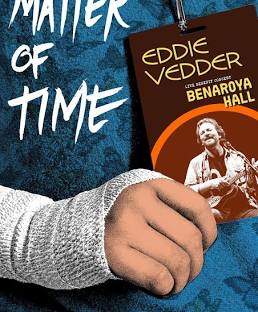
As a person with a rare disease (I’ve never liked that term) myself, and with a background in charity work, I was very curious to see how a small charity in America had recruited a hero of mine, a statesman of rock with a global outreach and what they had done with that.
The Netflix documentary Matter of Time (2025) is balanced between footage of Eddie Vedder playing a benefit gig in Seattle in October 2023, the search for a cure led by him and his wife Jill and an insight into the lives of some of the children and young people with an incurable rare disease as they travel to it with their families.

Born in 1964, Eddie Vedder is the vocalist of rock band Pearl Jam. In 2017, he was inducted into the Rock and Roll Hall of Fame as a member of Pearl Jam. Vedder has long been an outspoken political activist, standing up for people without a voice. He called out Ticketmaster in 1994, accusing them of operating a monopoly and charging unfair fees. Pearl Jam founded the Vitalogy Foundation in 2006 to support the efforts of non-profit organizations doing work in the fields of community health, the environment, arts & education and social change.
Epidermolysis Bullosa (EB) is a devastating and life-threatening genetic skin disorder that affects children from birth. Individuals with EB lack critical proteins that bind the skin’s two layers together, causing the skin to tear apart, blister, and shear off, leading to severe pain, disfigurement, and internal and external wounds that may never heal. The majority battling EB are children, as many don’t live long into adulthood. Children with EB are often called “Butterfly Children” because their skin is as fragile as the wings of a butterfly.

It’s is a matter of great fortune for a small charity when a big celebrity becomes associated with them. They will raise the awareness of the charity and the condition it represents. In most cases, there is a direct connection between a celebrity and the condition – either a family or friend. Jill’s entry on Wikipedia tells us that she has a childhood friend whose son was born with EB. Eddie and his wife Jill were founders of the Epidermolysis Bullosa Research Partnership (EBRP) in 2010 and have made some very impressive progress; getting a treatment approved by the Food and Drug Administration (FDA), the gatekeeper for the availability of medicines in the US.
Jill takes on the heavier narrative work of introducing the condition, the families and the initiative to find a cure. A philanthropist herself, she represents causes such as Global Citizen, Moms Demand Action, Planned Parenthood and Babes Against Brain Cancer. I really liked her positivity, talking about finding a cure as for EB as something that is going to happen. It reminded me of advice Arnold Schwarzenegger gives in his 2023 self-help book, Be Useful. If you have a goal that other people just can’t see, change the way you talk about it. Express it as something that is happening, and believe it. This motivates other people and increases the positivity around the effort, making it more likely to happen.
Eddie talks about what drew him to this cause. What comes through strongly is his sense of empathy not sympathy for those with EB. He empowers them, saying “these kids have earned the right to be cured” which is different to relying on the more traditional medical model of disability and saying: these kids are so helpless, we need to fix them.
We are shown the sheer heartbreak of the parents. Involving parents can complicate things. On one hand, we can easily feel their grief and desperation, they have such fierce energy to change their world. The title Matter of Time fits neatly into these ideas. But their natural overprotection can be smothering and make it difficult for their children to be seen and become independent.
The documentary delicately balances this raw anguish with by looking at the independence and creativity of their children. We learn about an initiative introduced by one family, called “Come Say Hi” which aims to take it the stigma out of physical disabilities by inviting passers-by to come and talk to disabled people, rather than just staring and being embarrassed. This is a very difficult thing for disabled children to do, stepping out of shame and being seen.
We meet a young man with advanced EB, selflessly submitting himself to painful clinical trials for new treatments because only he can provide useful results. These things are already common in the rare disease community, but the important message here is that we are not alone; there are over 10,000 rare diseases around the world.

Bringing families, doctors, researchers and biotech companies together in an event is a great way of bringing much needed focus, but is not new to rare disease. AtaxiaUK have been doing this for many years. What is innovative about this approach is the charity’s use of venture philanthropy. EBRP injects capital and leadership support into pharmaceutical start-ups in return for equity in the company. They then sell this equity and reinvest the profit in finding a cure for EB. They have raised over $75m since 2010.
By comparison, AtaxiaUK do not have such a laser focus on finding a cure for any one of the Ataxias, but raising awareness and building a nurturing, supportive community. They do not play the stock-market, but have invested over £6.75m in research since 2000, generating up to 5 times more from other funders. Our two charities may operate on different scales and in different markets, but the scientific breakthroughs that EBRP make, especially the use of CRISPR gene-editing therapy, will be of vital importance to the entire global rare disease community.
Everything comes together nicely for the final part. The concert is held at the Benaroya Hall, home to the Seattle Symphony Orchestra. This is Eddie’s home-town, the audience are his extended friends and family. If you were a teenager in the 90s you will now be somewhere in your 40s at the very least. Most of the audience looked to be around this age.

I was privileged to see Eddie Vedder perform in June 2017 at London’s Hammersmith Apollo. The set, a comfortable studio with Eddie surrounded by open suitcases, a real to reel tape recorder and an upright organ. Eddie sat on a stool wearing a hat and sharing his solo songs with us in the UK for the first time ever. For the second half of his set, a canopy of glittering stars appeared over the stage and the audience was transported to a magical evening under the night sky. Six years on, much of the stage was set up in this way for this concert too.
Eddie warmly welcomes several people with EB who have travelled with their families, and a dedicated researcher. In a touching reversal of rockstar-audience norms, Eddie introduces them as his heroes, tells a little story about each and sings a song or dedicates one to them.
Rise is setup for the climax. Deanna, one of the people with EB that we have followed, promises “We will rise up’ and the bright opening mandolin chords drift in. This is such a beautiful song, it is a burst of enthusiasm, resolve and hope for a fresh beginning. It is one of my favourites songs too, I selected it for the playlist to accompany my book.

The documentary ends on a poignant note – a reminder that finding a cure really is matter of time for all of us.
Richard C Brown MBE – May 2026
