
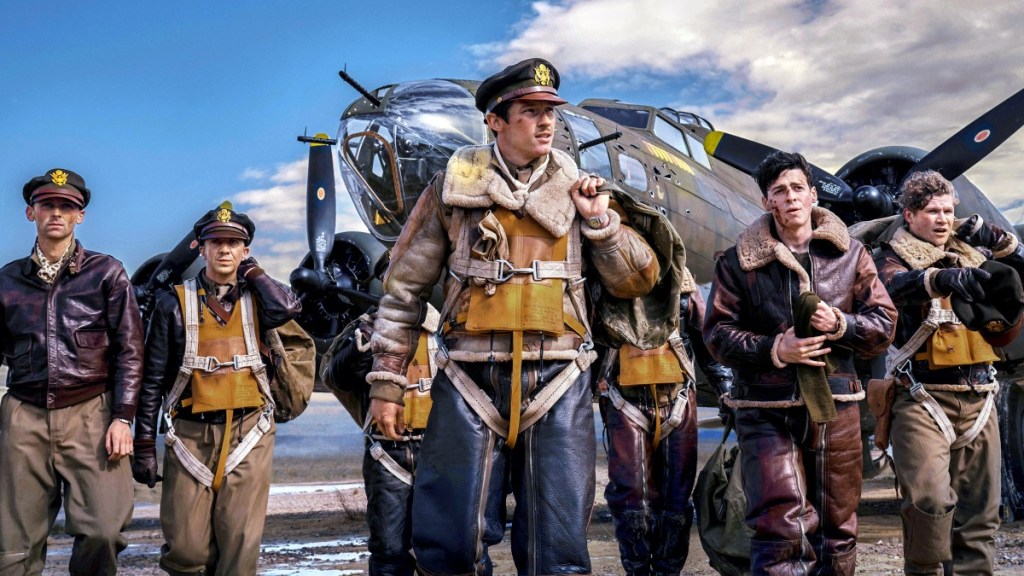
I’ve been enjoying Apple TV’s excellent Masters of the Air, a new drama series about the American bomber crews who fought alongside us in the Second World War. This post started as a review, but when returning from a routine mission last week, our vehicle sustained some critical damage of its own and we had to bail out. Only I couldn’t, I was trapped. In that moment, TV and real-life clashed uncomfortably.
Based on the book, Masters of the Air (2007) by Donald Miller and produced by Tom Hanks and Steven Speilberg, the series follows the fortunes of the 100th Bomb Group as they are deployed to Station 139, Thorpe Abbotts, Norfolk, in June 1943. The ‘Bloody Hundredth’, so called because of their high casualty rates, flew the B-17 Flying Fortress over occupied Europe. This 4-engined heavy bomber produced by Boeing in the USA from 1936-45 was renowned for its ability to absorb damage and had a crew of ten: Pilot, co-pilot, navigator, bombardier/nose gunner, flight engineer/top turret gunner, radio operator, two waist gunners, ball turret gunner and tail gunner.
The story of the B-17 is already very familiar to me. Released in 1982, B17 Bomber was an early flight simulator, notable because it used the Intellivision speech module. To introduce the game a voice would announce: “Bee sayvunteen bawmur” with heavy Southern drawl. I spent many hours in the air, being pounded by flak, fending off fighters and bombing oil refineries. Then there was the 1990 Bratpack film Memphis Belle, which follows a B-17 crew as they try to complete their 25th and final mission. According to the American Air Museum, the chance of surviving that long was just 28.32%. According to the Bloody 100th Foundation, chances of survival for their crews were so low, they were calculated in missions completed, their average was just 11.
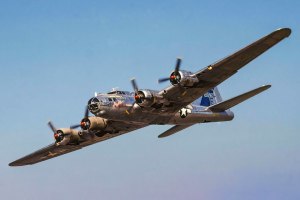
There are just four airworthy ‘Forts’ left. One is based in Britain at RAF Duxford. ‘Sally B’ is part of the Battle of Britain group of planes which you often see at commemorations and air shows. It was used in the filming of Memphis Belle. I have been lucky enough to see her in the air and on the ground a few times.
I am not an aviation expert, but as a historian, I am a stickler for detail. I know enough of the basics to render a film about B-17 crews into an uncomfortable watch if not handled properly. For example: Flying at 20,000 feet, the temperature drops to 25c below freezing, any exposed skin would instantly freeze on to any metal object touched. The crew had to wear heated flying suits with their helmets and goggles. The air was so thin up there, they had to carry oxygen canisters with them if they moved from their stations. Unlike the British who mainly bombed at night, the American chose to perform their missions during daylight. This brought greater accuracy, but much higher risk.
Fortunately, Masters of the Air does not trigger my ready scorn. Still only five episodes in, there are plenty of technical details to keep me interested: The use of flares to communicate between aircraft, the importance of the keeping in formation, record keeping and the need to reduce weight and drag when limping back to base were new to me. I had heard of ‘feathering the props’ many times, but had to look it up to find out what it meant. Allow me to mansplain it for you now: It is when the blades of a stalled propeller are angled into the oncoming air to reduce drag.
The missions in Masters of the Air are exciting, but the mortality rate is very high. Two of the characters are played by Austin Bailey (Elvis) and Ncuti Gatwa (Doctor Who). Probably two characters you would want up there with you in a tight spot. In the second episode, a snooty RAF type asks “Wouldn’t you rather fly a fighter?” An American pilot replies “I do fly a fighter, it just happens to be a bus.” A bus? I love buses. I knew I had to keep watching! To sustain the main story over a series, we follow those of the groundcrew, and downed crewmen on their escape from occupied Europe.
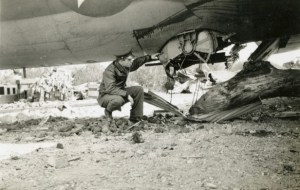
I also know something else: that a ball-turret gunner is likely to become trapped and die horribly. Well, I thought I knew that one. How? Popular culture told me. In Memphis Belle, the ball-turret gunner repeatedly complains about the reliability of his equipment. It does fail on a couple of occasions, the last at a critical moment and the turret is destroyed with him in it.
In an episode of Amazing Stories called The Mission in 1992, the pilot, a pre-fame Kevin Costner, has a terrible situation to deal with. The ball-turret gunner is trapped and the landing gear cannot descend. The plane will have to belly-land, killing the trapped man in the process. Once again, the crew try everything to release their friend, but must say an emotional farewell, reaching down to hold his hand. To ratchet up the tension even further, a priest in the control tower gives the last rites over the radio as the plane comes in to land. The wartime memoir of Andy Rooney My War (1995) recounts his story of a trapped ball-turret gunner meeting a fateful end in a belly-landing. Masters of the Air, also touches on the ball-turret gunner in distress trope. Their plane on fire, the crew bail out. The last to leave hears desperate shouting from the ball-turret.

Why is it such a powerful idea? It works so well for TV and film because the bigger scenario is rich with dramatic potential. As with any war film ever, it’s a group of young men from different backgrounds who must depend on each other for survival. It works as an emotional wrench and leads to bigger questions such as: the burdens of leadership (Spock in Star Trek 2: The Wrath of Khan anyone?), friendship and the futility of war. It speaks to a universal and primal fear of being trapped in an enclosed space, surrounded by friends who are powerless to help, and forced to await a painful and inevitable death far from home.
But it does not appear to be based on an actual incident. It’s a myth, as the Tri-State Warbird Museum‘s Collection Manager, Noha307, explains in his post “The Myth of the Crushed Ball Turret Gunner” on a WWII aviation forum: There is no actual incidence of a ball-turret gunner dying like this. The situation was very unlikely and there was still a lot a crew could to improve his chances of survival in a crash landing. Even though the slightly later B-24 Liberator featured a retractable ball-turret, the B-17 remained popular with bomber crews. This would suggest that the concern of being trapped inside a ball turret wasn’t very great amongst those crews. British crews bombing at night had no use for the extra weight and drag of a ventral turret, although some were fitted to Lancaster Bombers from 1944. Despite the wealth of information generated by every mission, Andy’s Rooney’s account cannot be evidenced.

How do I fit into this? In the last couple of months, we have been testing out a Wheelchair Accessible Vehicle (WAV). My wheelchair is anchored to the chassis of the vehicle (much like when I travel on our community bus). Although Helen drives as carefully as she can, I feel every bump as we bounce merrily through the flak (potholes). At least I get to hold hands with my son! We were returning from town on a fast road, there was a bump and an ominous rumbling noise. Helen braked sharply and we pulled over to the side of the road. We put the hazard lights on and got the kids to ‘bail out’ and stand on the verge while we figured out what to do next. We were only about hundred metres from the next village. It was the end of a winter afternoon we were being passed by fast-moving traffic, the skies were starting to darken. Anchored to the vehicle, I too felt exposed and trapped and just wanted to get off the road at any cost.
I tried to take control and calmly advised the pilot: “Just drive it nice and slowly in first gear and pull off the road when you get a chance.” Helen wasn’t sure. “I don’t think you can drive something with a flat tyre because it damages the wheel. I’ll ring my dad.” Now to be fair, John is a very good person to turn to in a crisis, we have done so have many times in the past. But as my order had been ignored, cars were whizzing past and I couldn’t escape, I felt the panic start to rise. I could imagine a lorry driver looking at his phone, not seeing us, ploughing into the back of us at speed and wiping us all out. I felt like the ball-turret gunner. Trapped and about to die. Helen ended the call. John was on his way. Minutes passed and we still weren’t moving. At least we weren’t on fire! I repeated my order, with much more urgency.
Eventually, we made it to the edge of the next village and pulled in to a residential road. We all got home safely. Over-thinking as usual, I wondered if my advice counted for anything anymore, was this just another loss of independence? After all, I used to be the pilot. In full control of my ship and everyone in it. As my condition progressed and I stopped driving, I became the co-pilot. At least I still had command of the radio and navigation and systems. Now, relegated to the back of the vehicle like a fragile piece of equipment or luggage, my role has changed again.
Though it is unlikely that a B-17 ball-turret gunner faced a greater risk of dying in combat than his crewmates, when I was trapped in our damaged vehicle, I felt the fear that we have been led to associate with being one.
Richard C Brown MBE – February 2024


Leave a Reply