
As my condition progresses, I am finding that I need more outside help. This is another time I have had to face an uncomfortable truth and embrace new and scary things. After a year of wearying admin, my Direct Payment is finally set up – what is it and has it all been worth it?
My wife is a teacher, so I have to be ready for the day when she leaves at 8 AM. I find the simplest of movements impossibly tiring and difficult when I am under stress. The muscles in my legs tense up, locking so I am unable to transfer from bed to chair and chair to toilet, shower seat and back. Then I need to stand awkwardly as my trousers are pulled up. All this with the kids shouting or being shouted at and the dog barking, I did not look forward to the mornings. But it wasn’t just me having a difficult time. As well as helping me, Helen had the extra stress of preparing my lunch the night before and my breakfast in the morning. Deep down, I knew something had to change.

Nearly dying from Covid at the end of 2023 changed everything for me. It sped up the progression of my condition. As I began my painfully slow recovery, I found I had lost confidence and a few simple movements were now beyond me. Apart from most of my clothes not fitting me anymore, I noticed I no longer had enough strength and coordination to bring a full pint glass up to my lips and transferring into and out of our car was becoming dangerous. We started using a Wheelchair Accessible Vehicle (WAV). We also had a ceiling hoist installed in the bedroom and trialled and ordered my first power chair with the Oxfordshire Wheelchair Service. These were all things that I didn’t need then, but my experience with Covid had sharpened my urgency to get the things I would need in place.
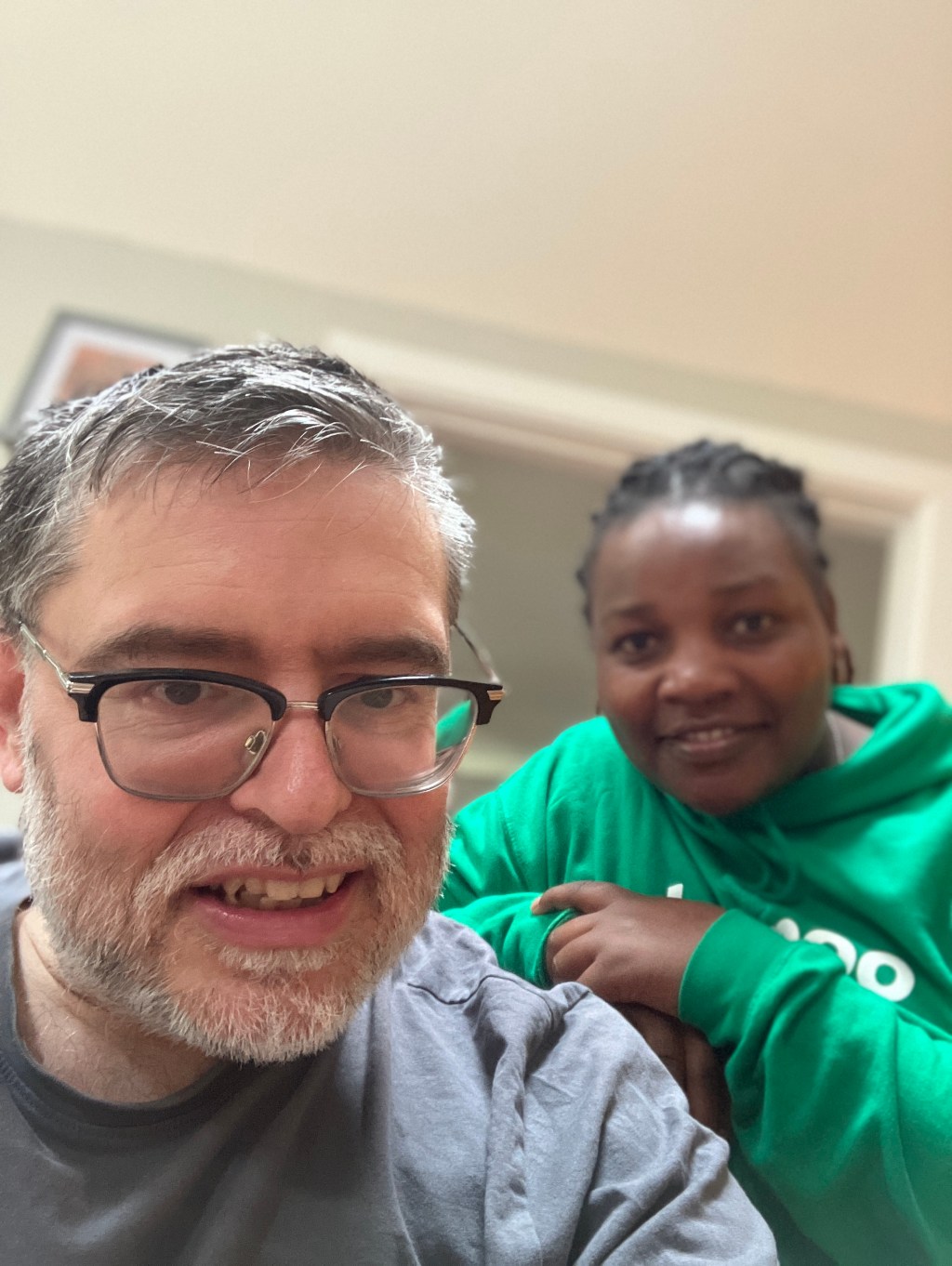
In May 2024, I found a PA to help me one morning a week. Given a break from the morning frenzy, I could relax and have a shower. The rest of the week, I would have to be up and ready at breakfast time. Much more than PA, Annet has become part of my life. Although I have worked with carers before, It still took a few weeks to get used to someone helping me in the bathroom. This also goes for the carer; getting used to a new client.
In August 2024, I had Covid again. Although not as bad as 18 months earlier, I was still unable to get out of bed for two weeks. We took advantage of the newly installed ceiling hoist and I relied on Helen (who had Covid herself) to look after me. As I began another slow recovery, it became clear that I needed to increase the amount help I was getting once again.
I turned to the UK’s creaking adult social care system for help. Under local authorities since the ’60s, it has never had sufficient investment or reform. Austerity from 2010 had a severe impact. Despite local authorities seeking to protect adult social care from the scale of cuts their other services faced, spending on social care did not keep up with need over the decade. Brexit did not help with recruitment or retention of carers. The Pandemic saw services stretch to breaking point. According to a recent report by the Institute of Fiscal Studies, Adult social care spending now accounts for more than 40% of all local authority spending on services to try and keep up. With very low expectations, I began the process in April 2024 to arrange the support I needed through Oxfordshire County Council.
My aim was to receive a Direct Payment. This is where you are allocated a weekly budget for your care. You choose and buy the services you need – you are the employer. It gives the flexibility and independence to use this budget as needed. It also frees the Council from a lot of admin! I had experience of a direct payment when Helen supported me on my exchange to the University of Rhode Island back in 2001. I could never have gone without it.
First, I needed a Financial Assessment. This is a means test to calculate how much you have to contribute to the care you need. You can complete the assessment online and attach recent bank statements and other evidence. The first time I did this, the online system reported errors and could not submit my form. When I tried this a second time with the same results, I emailed the team at the County Council. Their response was to send me a copy of the form to print at home and send in by post. When I explained that this form could only be completed by hand, no good for me – I was asked “can someone help you fill it in?” Deciding I had reached the limits of this process’s accessibility, I asked social worker who had been working on my case to fill the form in for me. Once it was submitted, it was decided that I need to fund roughly 30% of my care.
Next, I needed a Care Needs Assessment. This is an assessment of how much support you need every day. It also covers equipment, adapting your home or taking part in activities. As with any (mostly dehumanising) interaction with the state where a disabled person needs to prove their need, you need to put everyone around you before your pride. As difficult as it may be, rather than talk about what you can do, you need to ignore feelings of shame around asking for help and describe the support you need on your worst day. Luckily, I’ve just written a book about how to recognise and deal with those situations! I asked for support with weekday mornings, with Helen acting as my unpaid carer at weekends. Drawn up by a Social Worker, the finished plan has to be approved by a panel. I was prepared to appeal, to advocate for myself, but the panel approved the care I had asked for. The care plan is a working document, we will review it as my needs change.
Once I had submitted the identity documents needed to open a new bank account and to prove that any PAs employed correctly for tax purposes, I was issued with a prepaid card and employed a second PA.

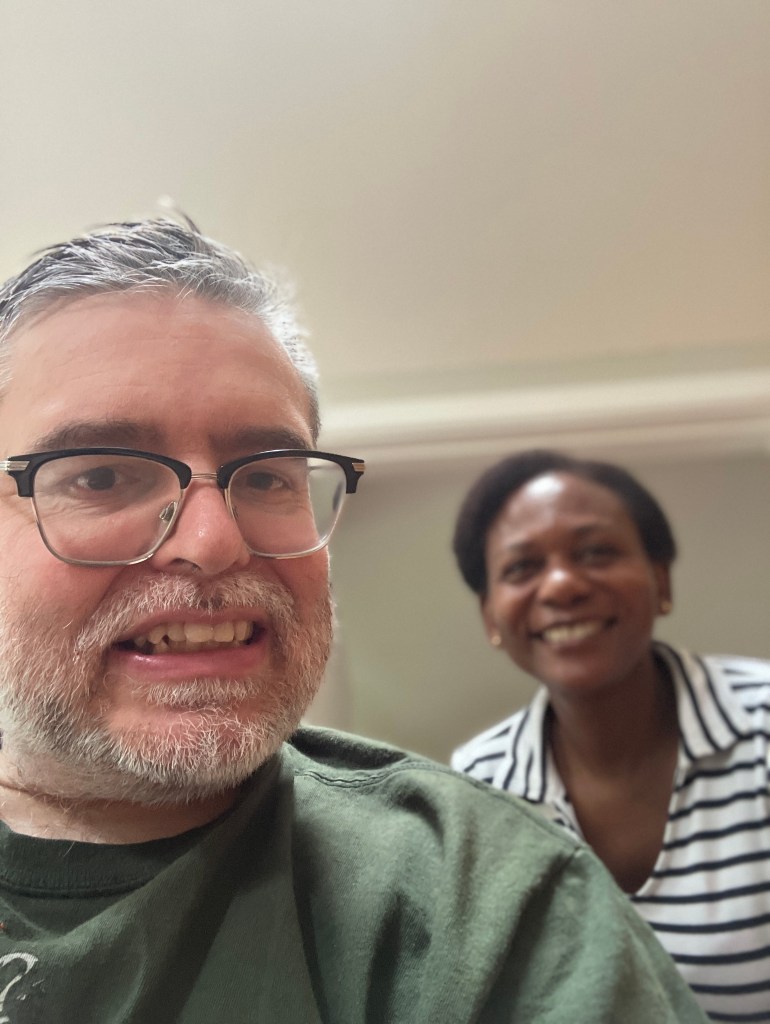
Now, my weekdays begin when my alarm goes off at 8:55 and this PA arrives with a cheerful “Good Morning!” While I’m in the bathroom, she empties the dishwasher. After she helps me to wash and dress, I am hoisted into my powerchair and have breakfast. We have wonderful and rambling conversations about our childhoods, customs in her native Zimbabwe and her experiences of care work while she tidies up and makes my lunch. Then it is time to say goodbye at 11.
I’m feeling happier and well looked after and I know this could slow the overall progression of my condition. Sure, my day is now 3 hours shorter and I don’t have any interaction with my wife and kids on weekday mornings, but my back hurts a lot less, I’ve increased my own independence and made new friends. I hope Helen feels a bit less rushed in the mornings too. Applying for a Direct Payment to manage my own care was frustrating at times, but definitely worth it.
Richard C Brown MBE – June 2025


Leave a Reply