
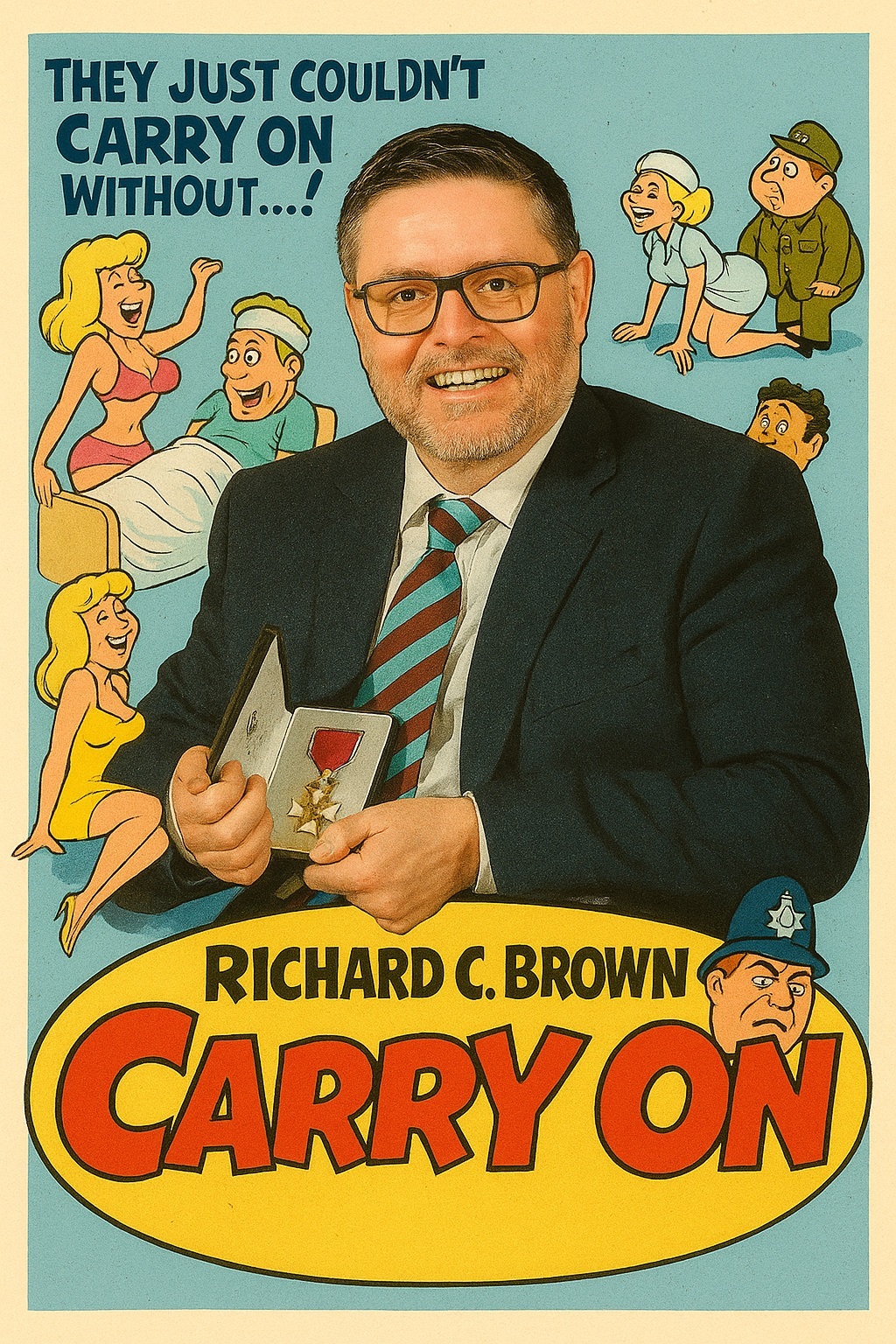
Bring back Carry-on Films!
I recently came across (Ooh er!) the 1992 attempt to reboot to the Carry On films. As a huge fan of the film franchise and a deep interest in comedy, I wondered if we could/should attempt to bring them back 32 years later.
Built on the popular British comedy traditions of music-hall and saucy postcard humour, the Carry On film franchise produced an impressive 30 films from 1958 to 1978. The films were carefully aimed at general audiences, avoiding outright nudity.
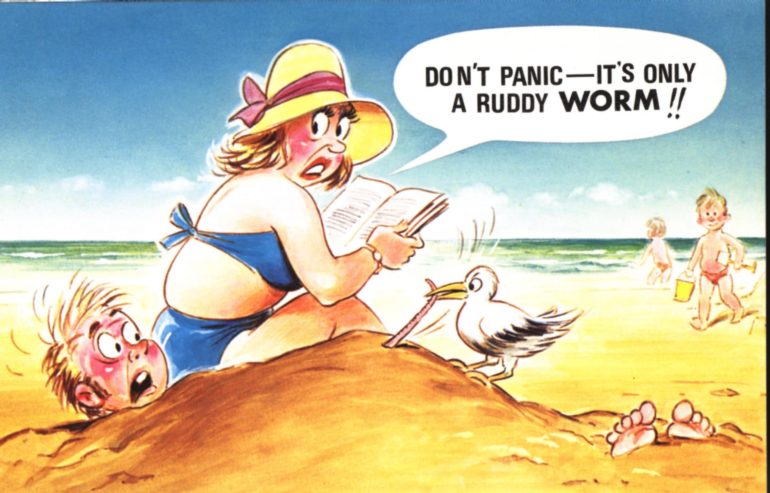
There was something uniquely ‘British’ about the films, World War II was still fresh in the minds of audiences and actors when the first films were made. Rationing had finally ended in 1954, people had lost so much and needed cheering up, and the world was moving on. The early films cleverly used the familiar post-war narrative of the plucky Brits with their backs against the wall, standing up to and overcoming pompous authority figures. Successful tv sitcoms such as On The Buses (1969-73), Dad’s Army (1968-77), Up Pompeii (1969-91) and Are You Being Served? (1972-85) followed a similar format and even made films of their own.
The use of familiar settings (hospitals, a cruise ship, a factory, a package holiday hotel, wartime), spoke to British audiences. With a core team of actors, a winning formula was quickly established and the producers successfully exploited a wide range of settings (Henry VIII, Dick Turpin, the British Empire, the Wild West) producing between two or three a year by the 1960s.
By the later 60s and 70s, many of the regular actors were in middle-age, often cast in the films as authority figures themselves. In his later years, Sid James was cast on tv sitcom Bless This House as a middle aged father, struggling to understand his modern, teenage children. The last Carry On film was made in 1978 (when I was 2) and many of the original cast had died or retired.
This is where I come in. Growing up in the 80’s, my world seemed quite a small place. We only had 3 TV channels, no mobile phones and no internet. There was school, our neighbourhood and the edge of a local town we could explore on our bikes, but not much else. Daleks were absolutely terrifying and you really had to use your imagination when playing computer games. Although they were kitsch, the Carry-on films were still on heavy rotation on television. They still promised that this smaller life could still be lots of fun.
I also liked the way the carry on films “punch upwards” and made anyone with authority look silly. Occasionally, the films gently explored gender, class and politics (Carry on Girls, Carry on at your Convenience), but not as thoroughly as the next generation of comedians like Monty Python. The producers knew exactly what their target audience wanted, and it wasn’t biting satire!
When Carry on Columbus was released in 1992 after a gap 14 years, the franchise became the second only to James Bond as the longest established British film franchise. I was excited. Carry on Columbus featured a new generation of comedians: Rik Mayall, Julian Clary, Alexi Sayle and Sara Crowe, alongside surviving members Jim Dale, Bernard Cribbins, Leslie Phillips and June Whitfield. It was directed by Gerald Thomas, the director of the original carry on film series. You can still watch it on YouTube. It was a fairly fast-moving story with plenty of cheeky double éntendres and sight gags.
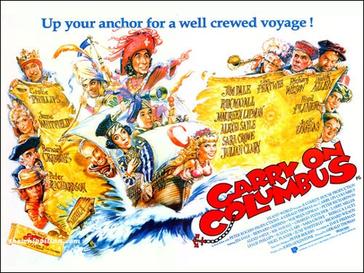
But the film was not a success. Although taking £1.6 million at the UK box office, it cost £2.5 million to make, critics hated it. It was an easy target. Revealingly, a 2004 poll of British actors, directors and technicians declared it the worst British film ever. I didn’t think it was that bad.
By trying to mark the 500th anniversary of Christopher Columbus discovering the Americas, Carry on Columbus strayed from the tried and tested formula. Critics pointed out that the subject matter wasn’t recognisably “British”. With the sole exception of Carry on Cleo (1964), all of the Carry on Films featured British characters in the main roles. Carry on Cleo took advantage of costumes and sets used at Pinewood Studios for the filming of Cleopatra (1963). After all, you wouldn’t make a Bond film without having James Bond in it.
For me, it’s more a question of obvious lack of investment in the film. The original films were filmed at Pinewood Studios in Buckinghamshire, on a notoriously tight budget. Carry on Columbus faithfully continued this tradition – and it shows. The sets and costumes look cheap. But it is the quality of the recording that is a giveaway. I tried to watch the film on YouTube, the footage was unwatchably grainy. It was probably recorded on a phone, I thought, ordering the DVD from eBay. When it arrived, the picture quality was better, but not much. It appears that the film was never released on DVD and my copy is a bootleg, probably recorded from VHS.
Securing the directing services of original director, Gerald Thomas, provided some continuity, but also limited the film when it came to action sequences. It made the film feel worn and tired – claustrophobic somehow. The scenes with Richard Wilson falling over on the deck and Julian Clary tangled up in ropes and spinning around in the ship’s hold looked and felt like something out of a vintage Carry On film. Maybe that’s exactly what the producer wanted, but it didn’t work for me. As a modern viewer, I expect Scorsese-like sweeps and clever camera shots to add depth to the story. The producers missed an opportunity to bring in a new director with different ideas.
You just couldn’t make those films today. They were white male heterosexual powerhouses of misogyny. They were of their time. It is now 60 years since the heyday of the Carry On films and Carry on Columbus was 33 years ago, thankfully the world has moved on. Those first films were made for the adults of that time, perhaps born in the first half of the century (like many of the stars of the films). Homosexuality was a serious crime punishable by imprisonment, sterilisation or even hanging until 1967.
Carry on Columbus was made just four years after Section 28, the infamous law prohibiting the inclusion of homosexuality in the curriculum was introduced. The writers obviously saw no reason to revert from traditional attitudes to homosexuality. When Richard Wilson introduces himself as Juan Pedro, Julian Clary’s character excitedly chimes ‘Ooh, I’m Juan too – Juan Diego‘. Maybe it was just too difficult to resist, this joke, about being one, a secret homosexual, was straight off the pages of a script written in the ’60s.
World War II is passing out of living memory, its echoes of collective loss, struggle and victory are fading away. The world has got so much bigger. References to rationing, the blitz and digging for victory may have lost much of their meaning, but we are still human. Sex will always be funny. We will always have henpecked husbands, middle-aged men chasing after younger partners, fetishists, outsiders, people using their sexuality to manipulate others, impotency, forbidden or unrequited love. We’ll always root for the plucky underdog enjoy seeing them get one over a bully or pompous authority figure.
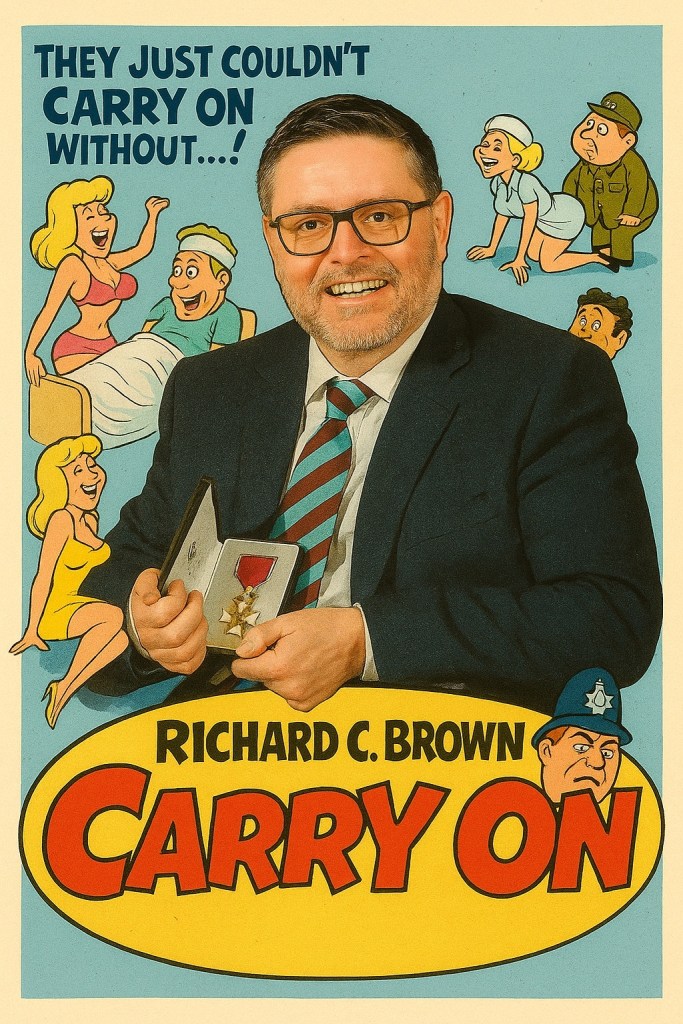
There was a rumour of a reboot in 2020, but the pandemic intervened and the moment passed. I think Carry On would work today. It would be so exciting to see the best acts of British comedy working together on something that would resonate with British audiences. All sexualities would be celebrated and female characters would need to drive the story rather than be objectified by it. Let’s bring them back. If I could be Involved in some small way, I’d be pleased to show my testimonials! (Ooh er!)
Richard C Brown MBE, May 2025


Leave a comment